Task
I run a small e-commerce business.
Not a big one. About 200 products. Mostly home goods. I write product descriptions myself, usually at night, usually while tired. It's not the fun part of the business.
So I started using AI to draft the descriptions. I'd give it the product name, a few specs, and a tone guide. It would produce a 100-150 word description. I'd review it, tweak it, and publish.
That worked for a while. Then I published a description with a wrong measurement. A customer bought the product, discovered the size was off, and asked for a refund. I lost the sale and the shipping cost.
I decided to audit every AI-written description before publishing. Here's what I found and what I now check.
Tool and Date
Tool used to generate the drafts: A general-purpose AI assistant (paid tier)
Date of audit: September 15, 2026
Products audited: 15
Description length: 100-150 words each
Original Input
Here's the prompt I use for each product.
"Write a 120-word product description for [product name]. Here are the specs: [specs]. Tone: warm, practical, not salesy. Audience: home cooks who want simple, durable tools."
I paste in the specs from my supplier's sheet. Then I review the output before publishing.
Claim Under Review
I checked every factual claim in each description. Here's what counts as a claim:
Measurements (dimensions, weight, capacity)
Materials (what the product is made of)
Features (what it does, what it includes)
Compatibility (what it works with)
Care instructions (how to clean or maintain it)
Origin or manufacturing claims
Warranty or guarantee claims
I didn't check subjective statements ("beautiful," "easy to use"). I checked facts.
Evidence
I checked each claim against three sources.
Source 1: The supplier's spec sheet. The document the supplier provided. It's the closest thing to a primary source.
Source 2: The physical product. For products I have in stock, I measured, weighed, and tested.
Source 3: The manufacturer's website. For products I don't have on hand, I checked the manufacturer's official product page.
Here's what I found across 15 descriptions.
Correct: 11 descriptions had no material errors.
Errors found: 4 descriptions had at least one material error.
Error type breakdown:
Wrong measurements (2): The AI rounded up or down. One product was described as "12 inches" when the actual length was 10.5 inches. Another was described as "2 pounds" when the actual weight was 1.6 pounds.
Invented feature (1): The AI described a product as "dishwasher safe" when the supplier's spec sheet said "hand wash only."
Wrong material (1): The AI described a product as "stainless steel" when the spec sheet said "stainless steel with a silicone coating."
None of these were dramatic. But each one could have led to a return, a refund, or a bad review.
Finding
Confirmed error rate: 4 out of 15 (27%).
That's too high for published product descriptions. Each error could have cost me a sale or a customer.
The errors clustered around specifics: numbers, materials, and features. The AI was good at the general tone. It was bad at the exact facts.
Risk
Here's what could have happened if I hadn't caught the errors.
The measurement errors. A customer buys based on the wrong size. The product doesn't fit. They return it. I pay the return shipping. I lose the sale.
The invented feature. A customer puts the product in the dishwasher because the description said it was dishwasher-safe. It gets damaged. They ask for a refund. I'm liable.
The wrong material. A customer has a nickel allergy. They buy the product because it's described as stainless steel. The silicone coating causes a reaction. That's a bigger problem than a refund.
The risk isn't just financial. It's trust. If a customer finds one error, they'll wonder what else is wrong.
The Checklist I Now Use
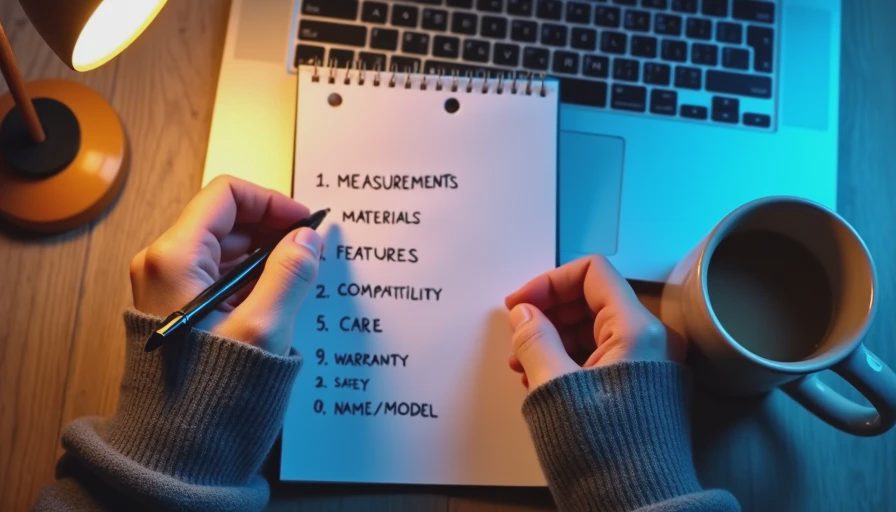
Here's what I verify before publishing any AI-written product description.
1. Measurements. Every dimension, weight, and capacity. I check against the spec sheet. If the AI rounds, I un-round it.
2. Materials. Every material mentioned. I check for coatings, finishes, and exact compositions. "Stainless steel" is not the same as "stainless steel with a silicone coating."
3. Features. Every function, setting, or included accessory. I check that each feature exists and works as described.
4. Compatibility. Every "works with" or "fits" claim. I check that the product is actually compatible with what the AI says.
5. Care instructions. Every cleaning, storage, and maintenance claim. I check against the manufacturer's guidance.
6. Origin and manufacturing. Every "made in" or "manufactured by" claim. I check against the supplier's documentation.
7. Warranty or guarantee. Every promise about returns, replacements, or guarantees. I check that I can actually honor it.
8. Safety claims. Every claim about safety, allergies, or certifications. I check against the supplier's compliance documents.
9. Product name and model number. I check that the AI used the correct name and model number.
10. No invented features. I check that every feature mentioned appears in the spec sheet. If the AI added something that wasn't there, I remove it.
That's my checklist. It takes about five minutes per product.
What I'm Asking the Community
What should a small business verify before publishing AI-written product descriptions?
I'm specifically interested in:
What did I miss on my checklist?
Do you have a different process?
Do you use AI for product descriptions at all?
Do you verify against a spec sheet, or do you have another source?
Do you have a way to scale this? I have 200 products. My checklist takes 5 minutes per product. That's 16 hours of work to audit everything.
Are there tools that help with this? Or is it always manual?
I'm also curious about tone. The AI descriptions were warmer and more consistent than my own. If I rewrite them to fix the errors, I lose some of that. Does anyone have a process for keeping the AI tone while fixing the facts?
And one more question: should I tell my customers? If I find an error in a published description, should I proactively reach out to past buyers? Or just fix it quietly? I'd like to hear what others do.
If you've built a checklist for this, please share it. I'd rather build a better one now than after another refund.
A Few More Details
I should mention: I've anonymized the products and suppliers. The pattern matters, not the specific items.
I should also mention: I didn't use AI to check AI. I checked manually against the source documents. I know some people use AI for QA. I haven't tried that. If you have, I'd like to hear whether it works.
If you have a faster or more scalable process, please share it. I'm trying to build a habit that works for 200 products, not just 15.
Comments
No comments yet — be the first to share a thought.