Task
I was researching a historical event for a personal project.
Not academic. Just curiosity. I was looking for photographs from a specific era. I found an image on a social media account that claimed to show the event. It had thousands of likes. It had comments saying "incredible" and "history comes alive."
I almost saved it. Then I noticed something small. I looked closer. I found four more things. By the end, I was fairly sure the image was AI-generated.
Here's what I found, and what I'm asking the community to check next.
Tool and Date
Tool used to generate the image: Unknown. I didn't generate it. I found it.
Where I found it: A social media account focused on historical photography.
Date I found it: September 14, 2026
Date of my audit: September 15, 2026
Tools I used to check: Reverse image search (Google, Bing, TinEye), EXIF data viewer, image editing software for zooming and color analysis.
Original Input
The image claimed to show a crowd gathered at a specific historic event in the 1940s.
The caption said: "Rare photograph of the crowd at [event], 1943. Colorized."
It had the visual style of a colorized historical photo. Warm tones. Slight grain. Period-appropriate clothing.
I didn't ask AI to generate it. I asked AI to help me check it.
Claim Under Review
The claim is: This is a real photograph, colorized, from 1943, showing the crowd at a specific historic event.
I wanted to know whether the image was authentic, AI-generated, or something in between.
Evidence
I found five clues. Here they are, in the order I noticed them.
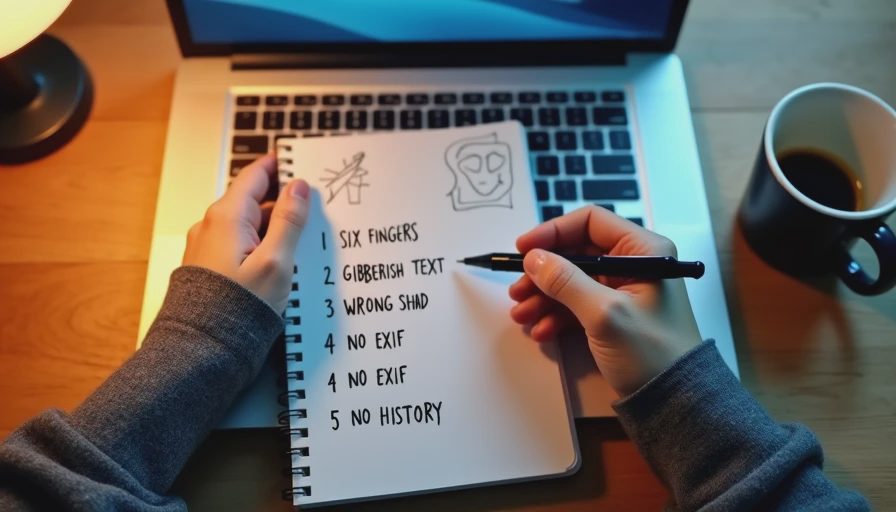
Clue 1: The hands in the foreground. A man in the lower-left corner has a hand resting on a railing. The fingers are wrong. There are six fingers. They're also too long and slightly curved in a way that doesn't match the rest of the hand.
Clue 2: The background text. There's a sign in the upper-right corner. It should say something. Instead, it's a series of letters that don't form words. "TRAPLO" and "HENDEN" and "MORST." It looks like text, but it's not.
Clue 3: The lighting. The sun is supposed to be behind the crowd. The shadows fall forward. But one person in the middle of the crowd has a shadow that falls backward. It doesn't match.
Clue 4: The EXIF data. I checked the file's EXIF data. The image had no camera information. No date. No GPS. No original dimensions. It had been stripped or never existed. That alone isn't conclusive—social media strips EXIF often—but it's a clue.
Clue 5: The reverse image search. I ran the image through Google, Bing, and TinEye. It returned no matches before 2024. The image appears to have originated online about 18 months ago. There's no record of it in any archive, museum, or historical collection.
I also noticed a sixth thing, but it's weaker. The color palette is too even. Real colorized photos from that era often have uneven color—some areas tinted more than others. This image has uniform color across the frame.
Finding
Partly correct — likely AI-generated, not a real historical photo.
I can't prove the image is AI-generated. I don't have the original file. I don't have the model. But the evidence points strongly in that direction.
The hands are anatomically wrong.
The background text is gibberish.
The lighting is inconsistent.
There's no historical record of the image.
The color is too uniform for a period colorization.
Any one of these could be explained. Together, they're hard to explain away.
Risk
The image was shared thousands of times. Some of those shares likely treated it as real. If it is AI-generated, then a fabricated image is circulating as historical fact.
The risk isn't just this one image. It's the pattern. AI-generated historical images are becoming common. They're convincing. They spread fast. And they're hard to debunk once they're in circulation.
If a student uses this image in a paper, they're citing a fake. If a journalist uses it in a story, they're spreading misinformation. If a museum adds it to a collection, they're corrupting the archive.
Lesson
Here's what I learned from this audit.
Hands are a strong signal. AI image generators still struggle with hands. Look at fingers, joints, and proportions. It's not a perfect test, but it's a fast one.
Text in the background is a strong signal. AI often produces gibberish text. If you see letters that don't form words, that's a clue.
Lighting should be consistent. If the shadows don't match the light source, something is wrong. This is harder to spot, but it's worth checking.
Reverse image search is essential. If an image has no history before a recent date, that's a clue. If it appears in multiple places with the same caption and no source, that's a bigger clue.
EXIF data matters, but it's not conclusive. Social media strips EXIF. So the absence of EXIF isn't proof. But it's one piece of evidence.
Colorization has a signature. Real colorized photos from the 1940s have uneven color. AI-generated images often have too-perfect color. That's a weaker clue, but it's worth noting.
The pattern matters more than any single clue. Any one of these could be a coincidence. All five together are hard to explain.
What I'm Asking the Community
I've done my audit. Now I want the community to check it.
Here's what I'm asking.
1. Do you see the same five clues? Or am I imagining them? If you can find the image, look at the hands, the text, the lighting, the EXIF, and the search history. Do you see what I see?
2. What would you check next? I've done reverse image search, EXIF, and visual inspection. What else should I check? Are there tools I'm missing?
3. Is there a way to prove the image is AI-generated? Or can I only say "likely"? I'd like to know if there's a definitive test.
4. What should I do with the finding? Should I comment on the original post? Should I contact the account that posted it? Should I just let it go? I'm not sure what's appropriate.
5. Should this forum have a standard way to report image cases? I've seen image audits scattered across different posts. Maybe we need a template.
I'm also curious about the broader pattern. Have you seen AI-generated historical images circulating as real? How do you spot them? What do you do when you find one?
And one more question: is there a way to train yourself to spot these faster? I found these five clues, but it took me 20 minutes. I'd like to get faster.
If you have a checklist for image verification, please share it. If you've audited a similar case, I'd like to compare notes. If you think I'm wrong about any of these clues, tell me. I'd rather be corrected now than after I've shared a wrong conclusion.
A Few More Details
I should mention: I've anonymized the event and the account. The pattern matters, not the specific source.
I should also mention: I didn't post the image here because I don't have permission. I can describe it, but I can't share it. If the moderators want me to share it privately for verification, I can do that.
If you have experience with AI image detection, please share it. I'm trying to build a habit that works for everyday users, not just experts.
Comments
No comments yet — be the first to share a thought.