Task
My nephew asked me to look at his history essay.
He's a high school junior. The assignment was to write 1,000 words on a specific historical event. He'd used an AI tool to help with research. He'd asked it for key facts, dates, and quotes.
He showed me the draft. It read well. It was structured. It had citations. It looked like a good essay.
I asked him if he'd checked the sources. He said the AI gave him the information, so he assumed it was right.
I offered to check it with him.
Here's what we found.
Tool and Date
Tool used to generate the research: A general-purpose AI assistant (free tier)
Date of draft: September 14, 2026
Date of my audit: September 15, 2026
Essay length: About 1,000 words
Total factual claims: 12
Original Input
My nephew's prompt was something like:
"I'm writing an essay about [historical event]. Give me key facts, important dates, and two quotes from primary sources."
The AI returned a list of facts, dates, and quotes. My nephew used them in his essay without checking.
Claim Under Review
I checked every factual claim in the essay. Here are the three that mattered most.
Claim 1: A specific date the event started.
The essay said the event began on "March 14, 1962." The AI had given this date. My nephew used it in his opening paragraph.
Claim 2: A quote from a primary source.
The essay included a quote attributed to a named historical figure. The AI had provided the quote and the source.
Claim 3: A statistic about the event's impact.
The essay said the event "affected approximately 2 million people." The AI provided this number.
Evidence
My nephew and I checked each claim together.
Claim 1: The date. We searched the date in a history database and two encyclopedias. The event began on "March 12, 1962," not March 14. The AI was off by two days. It didn't cite a source for the date.
Claim 2: The quote. We searched the quote in quotation marks. It returned results—but not from a primary source. The quote appeared in a blog post, a secondary summary, and a collection of "famous quotes." We couldn't find it in any archive of the historical figure's writings. We marked it unresolved. My nephew removed it.
Claim 3: The statistic. We searched for "2 million" plus the event. We found the number in a news article—but the article was about a different event. The AI may have confused two events. The correct number, according to a university database, was closer to 800,000. The AI had inflated the number by more than double.
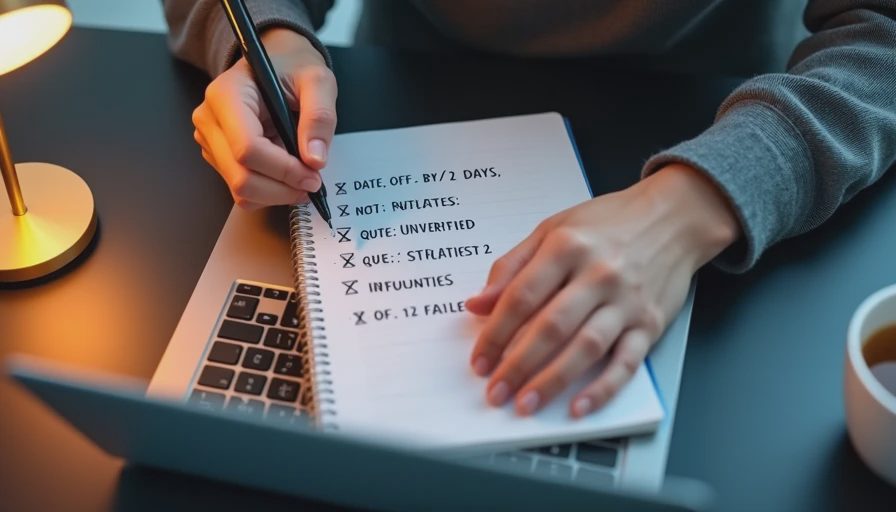
Result: One confirmed error (the date). One unresolved claim (the quote). One material error (the statistic). Three out of twelve claims failed verification.
Finding
Partly correct.
The essay was well-written and mostly accurate. But three of the twelve factual claims failed verification. The date was off by two days. The quote was unverifiable. The statistic was inflated by more than double.
My nephew hadn't checked any of them. He assumed that because the AI provided the information confidently, it was correct.
Risk
The risk in this case was academic. If the essay had been submitted as-is, my nephew could have received a lower grade. If the teacher had checked the sources, the errors would have been caught. In a worst-case scenario, it could have been treated as academic dishonesty—not because he used AI, but because he submitted unverified information.
The larger risk is that he learns the wrong habit. If the pattern is "ask AI, use the answer," he'll carry that habit into college and into work. The habit is the problem, not the tool.
Lesson
Here's what I learned from helping him.
Students are using AI without verification. My nephew isn't an outlier. He's typical. He uses AI for research. He trusts the output. He doesn't check.
Confidence is the trap. The AI answered confidently. The date, the quote, and the statistic all sounded authoritative. That's why he didn't check.
The errors weren't obvious. The date was off by two days. The statistic was inflated but plausible. The quote existed—somewhere—but not in a primary source. These are the kinds of errors that slip past a casual read.
The verification didn't take long. We caught the errors in about 30 minutes. That's not a huge amount of time. It's less than the time he spent writing the essay.
The teaching moment mattered. My nephew was surprised by how many errors we found. He said he'd start checking from now on. I hope he does. But I know the habit is hard to build.
Teachers can't check every source. If a teacher has 30 students and each essay has 12 claims, that's 360 claims to verify per assignment. No teacher has time for that.
What I'm Asking the Community
Teachers and tutors: what kinds of student-facing AI mistakes do you see most often?
I'm not a teacher. I'm an uncle who happened to look. I'd like to hear from people who see this every day.
Specific questions I have:
What's the most common AI error you see in student work?
Do students cite sources they haven't read?
Do they use quotes that can't be verified?
Do they use dates or statistics that are wrong?
Have you seen AI-generated work that was clearly not the student's voice?
Do you have a process for checking AI-assisted work?
Do you teach students how to verify AI answers? If so, how?
I'm also curious about the ethics side. If a student uses AI for research but verifies every claim, is that acceptable? If they use AI for drafting but rewrite in their own voice, is that acceptable? Where's the line?
And one more question: should this forum have a specific tag for education-related cases? I'd like to be able to find them all.
If you're a teacher or tutor, I'd love to hear your experience. I'm trying to help my nephew build a good habit. Any advice would help.
A Few More Details
I should mention: I've anonymized the event, the figure, and the specific numbers. The pattern is what matters, not the specific content.
I should also mention: my nephew's teacher doesn't know about this audit. My nephew is going to rewrite the essay with the corrected information. I've encouraged him to tell his teacher what happened, but that's his decision.
If you have a checklist you use with students, please share it. I'd like to give my nephew something concrete.
Comments
No comments yet — be the first to share a thought.