Task
I use AI transcription for client meetings.
Not for legal or medical work. Just standard business calls. Project kickoffs, check-ins, follow-ups. The tool saves me time. Instead of taking notes during the call, I focus on the conversation and review the transcript afterward.
Last week, I reviewed a transcript from a one-hour client call. It looked clean. It read smoothly. Names were spelled correctly. Numbers were formatted neatly.
Then I noticed something. One of the numbers was wrong. Not by a little. By a lot. I checked further. I found more errors.
Here's what happened and the workflow I'm now building.
Tool and Date
Tool used: An AI transcription service (paid tier)
Date of meeting: September 12, 2026
Date of audit: September 14, 2026
Meeting length: 58 minutes
Participants: 4 (2 from my side, 2 from the client side)
Transcript length: About 8,500 words
Original Input
The meeting was a project check-in. We discussed:
Project timeline
Budget adjustments
Two vendor names
Three numerical figures (a percentage, a dollar amount, and a date)
I recorded the call with consent. I uploaded the recording to the transcription tool. I received a transcript about 10 minutes later.
Claim Under Review
The transcript looked accurate at first read. But after reviewing it against my own notes, I found five errors.
Error 1: Wrong name. The client's project lead is named "Marissa." The transcript consistently wrote "Melissa." This appeared 14 times.
Error 2: Wrong name. One of our vendors is named "Cobalt Systems." The transcript wrote "Cobalt Solutions." This appeared 6 times.
Error 3: Wrong number. We discussed a budget adjustment of "$45,000." The transcript said "$54,000."
Error 4: Wrong percentage. We discussed a "12% increase in scope." The transcript said "20%."
Error 5: Wrong date. We agreed on a deadline of "October 15." The transcript said "October 5."
Evidence
I compared the transcript against three sources.
Source 1: My own notes. I take brief handwritten notes during meetings. They're not detailed, but they captured the names, the numbers, and the date.
Source 2: The recording. I listened to the recording at the timestamp for each error. In each case, the audio was clear. The AI had simply misheard.
Source 3: A follow-up email. After the meeting, the client sent a summary email. It confirmed the budget figure, the percentage, and the deadline. All three matched my notes, not the transcript.
Result: All five errors were confirmed. The transcript was wrong five times in 8,500 words.
Finding
Confirmed error — 5 errors in one transcript.
The transcript was fluent. It was well-formatted. It read like a professional document. But it contained five material errors, all of which changed the meaning of the conversation.
Two were name errors, which would have been embarrassing if I'd sent the transcript to the client without checking.
Three were number errors, which could have led to real problems if anyone had relied on the transcript for a decision.
Risk
Here's what could have happened if I'd trusted the transcript.
The name errors. If I'd used the transcript to draft a follow-up email, I would have called the client's project lead by the wrong name. That's a small but real credibility hit.
The budget error. If someone on my team had read the transcript and started planning against "$54,000," they would have been working with the wrong number. When the real budget of "$45,000" came up later, there would have been confusion.
The percentage error. "20%" vs "12%" is a significant difference in scope. If the transcript had been used as the record of the meeting, it would have misrepresented what was actually agreed.
The date error. "October 5" vs "October 15" is a ten-day difference. If that transcript had been used as the source of truth, someone could have missed a deadline.
The risk isn't that the transcript was wrong. It's that the transcript looked right. The errors were buried in an otherwise clean document.
Lesson
Here's what I learned from this audit.
Transcription tools are not accurate enough to use unchecked. The transcript was 99.94% accurate by word count. But that 0.06% contained five material errors. Accuracy percentages don't capture material risk.
Names and numbers are the highest-risk categories. The AI got the general conversation right. It got the specific names and numbers wrong. That's the pattern. Names and numbers matter more than anything else in a transcript.
The transcript reads well, which makes it dangerous. A transcript that looked confused would be easy to distrust. A transcript that reads smoothly is easy to trust. The smoothness hides the errors.
My notes caught the errors. I didn't catch the errors by reading the transcript. I caught them by comparing the transcript to my own notes. Without my notes, I would have missed all five.
The recording is the primary source. The transcript is a summary. The recording is the source. If something matters, I check the recording.
A five-minute review isn't enough. I can't read an 8,500-word transcript and catch every error in five minutes. I need a specific workflow.
The Correction Workflow I'm Building
Here's what I'm doing now.
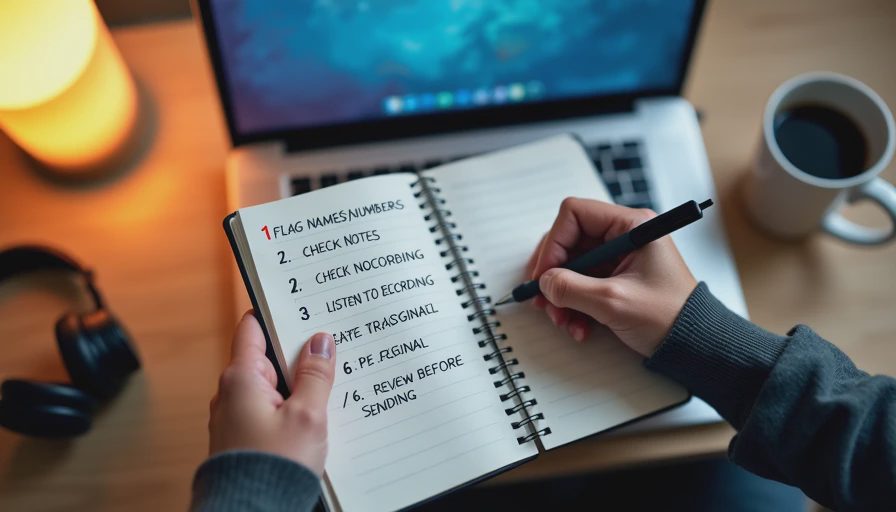
Step 1: Flag the high-risk categories before reading. Names, numbers, dates, and percentages. I scan the transcript for these first.
Step 2: Compare each flagged item against my notes. If my notes don't have the item, I check the recording.
Step 3: Listen to the recording at each timestamp. I don't listen to the whole recording. I listen to the 10-second window around each flagged item.
Step 4: Correct the transcript. I fix the errors in the transcript. I also add a note at the top: "Reviewed against recording on [date]. [Number] corrections made."
Step 5: Keep the original. I save the original transcript separately. If someone asks how I arrived at a fact, I can show both versions.
Step 6: Don't send the transcript to clients without review. I don't send the raw transcript. I send a summary I've written myself, based on the reviewed transcript and the recording.
That workflow takes about 20-30 minutes for a one-hour meeting. It's not fast. But it catches the errors.
What I'm Asking the Community
What is your correction workflow for AI transcripts?
I'm specifically curious about:
Do you review every transcript, or only high-stakes ones?
What categories do you check first?
Do you compare against notes, the recording, or both?
Do you have a way to catch errors faster than 20-30 minutes?
Do you ever send the raw transcript to clients, or always rewrite?
Do you add a "reviewed" label to the transcript? What does it say?
Do you keep the original and corrected versions, or just the corrected one?
I'm also curious about different types of meetings. My case was a project check-in. Does the workflow change for sales calls, interviews, or legal meetings?
And one more question: is there a tool that does this automatically? I know some transcription services offer "speaker identification" and "confidence scores." Do those help? Or do they just give a false sense of accuracy?
If you have a workflow that works, please share it. I'd rather build a better one now than after another wrong number goes to a client.
A Few More Details
I should mention: I've anonymized all names, vendors, and figures. The pattern matters, not the specific content.
I should also mention: I didn't send the flawed transcript to anyone. I caught the errors before it left my desk. But the fact that I almost sent it is what prompted this post.
If you've audited a transcript, please share your experience. If you've been burned by a transcript error, I'd like to hear about it. I'm trying to build a habit that works for everyday business use, not just high-stakes legal cases.
Comments
No comments yet — be the first to share a thought.