
Task
I've been using AI tools for about a year now.
Not for anything complicated. Just everyday stuff. Emails. Summaries. Research. Brainstorming. I'm not a developer. I'm not a researcher. I'm just a person who uses AI to get through the day.
For most of that year, I trusted the output. If it looked right, I used it. If it sounded confident, I assumed it was correct.
Then I got burned. Twice.
The first time, the AI gave me a wrong statistic. I used it in a report. My manager caught it. It was embarrassing.
The second time, the AI invented a source. I almost cited it. I caught it at the last minute. But it scared me.
So I started checking. Not obsessively. Just enough to catch the obvious errors. I built a five-minute audit. It's not perfect. But it's saved me more than once.
I'm writing this for anyone who's just starting to check AI answers. Here's what I do.
The Five-Minute Audit
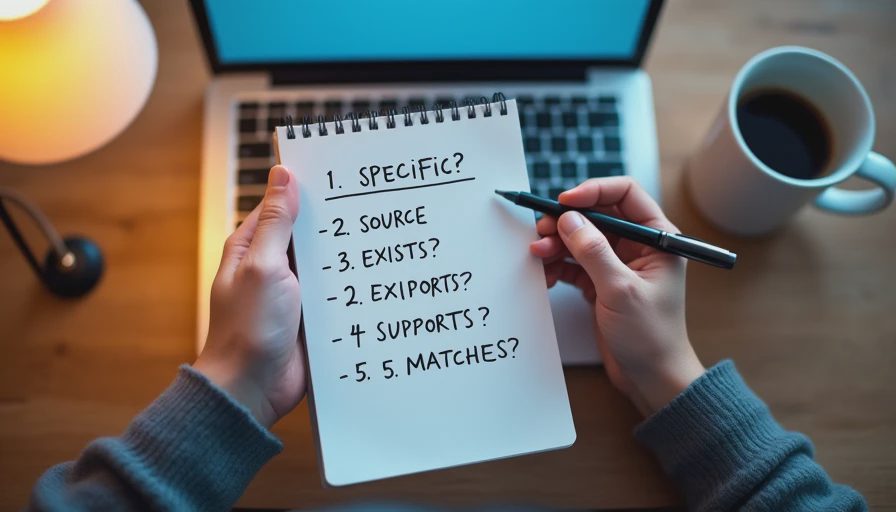
I check five things. Each one takes about a minute.
1. Is the claim specific? Vague claims are hard to check. Specific claims are easier. If the AI says "many studies show," that's vague. If it says "a 2021 Stanford study found," that's specific. I check specific claims. I flag vague claims as "unresolved."
2. Does the AI cite a source? If there's no source, I don't trust the claim. If there's a source, I check it. I look for the title, the author, the date, and a link. If any of those are missing, I flag it.
3. Does the source exist? I search for the source. I copy the title into a search engine with quotation marks. If there are no exact matches, I flag it. If there are matches, I open the source. If the source is a PDF, I check it. If the source is a webpage, I check it.
4. Does the source actually support the claim? This is the part most people skip. Finding the source isn't enough. I have to check whether the source actually says what the AI says it says. Sometimes it does. Sometimes it says something different. Sometimes it says the opposite.
5. Does the claim match my own knowledge? If the claim contradicts something I know, I check it more carefully. If the claim is unfamiliar, I check it too. I don't trust my own knowledge completely. But I trust it enough to flag things that seem off.
That's it. Five checks. Five minutes. It's not perfect. But it catches most errors.
A Real Example
Let me show you how this works.
I asked AI for information about a local business regulation. It said: "The requirement was updated in 2023 to allow X."
Check 1: Specific? Yes. It mentioned a year and a specific change.
Check 2: Source? No source. That's a red flag.
Check 3: Source exists? No source to check. But I searched the claim directly. I found the city's website. It said the requirement was updated in 2022, not 2023. And the change was different.
Check 4: Source supports claim? The source contradicted the claim. The AI got the year wrong and the change wrong.
Check 5: Matches my knowledge? I didn't know the regulation. But I knew regulations often change. So I checked.
Finding: Confirmed error. The AI got the year wrong and the change wrong.
If I had trusted the AI, I would have made two mistakes.
What to Skip
Not everything needs a five-minute audit.
Low-stakes output. If you're brainstorming ideas or drafting a personal email, you don't need to check every claim. The risk is low.
Output you already know. If the AI says something you already know is true, you can skip the check. But be careful. The AI might be saying something you think you know, but it's wrong.
Output that's obviously wrong. If the AI says something that's obviously wrong, you can skip the check. But be careful. Sometimes the wrong thing sounds right.
Output you're not going to use. If you're not going to use the output, you don't need to check it. Don't waste your time.
I use the five-minute audit for anything that's going to a client, a manager, or a publication. For everything else, I use my judgment.
The Biggest Mistake Beginners Make
The biggest mistake is trusting confidence.
The AI sounds confident. It sounds authoritative. It sounds like it knows what it's talking about.
But confidence is not accuracy. The AI can be confident and wrong. It can be confident and made up. It can be confident and outdated.
I've learned to ignore confidence. I look for sources. I look for specifics. I look for evidence. Confidence doesn't matter.
What I'm Asking the Community
What should a five-minute AI answer audit include for someone who is just starting?
Do you have a checklist? Do you have a routine? Do you check different things than I do?
I'm also curious: what do you skip? What's the lowest-stakes output you don't bother checking? And what's the highest-stakes output you always check?
I'd like to build a better five-minute audit. Any advice would help.
Comments
No comments yet — be the first to share a thought.