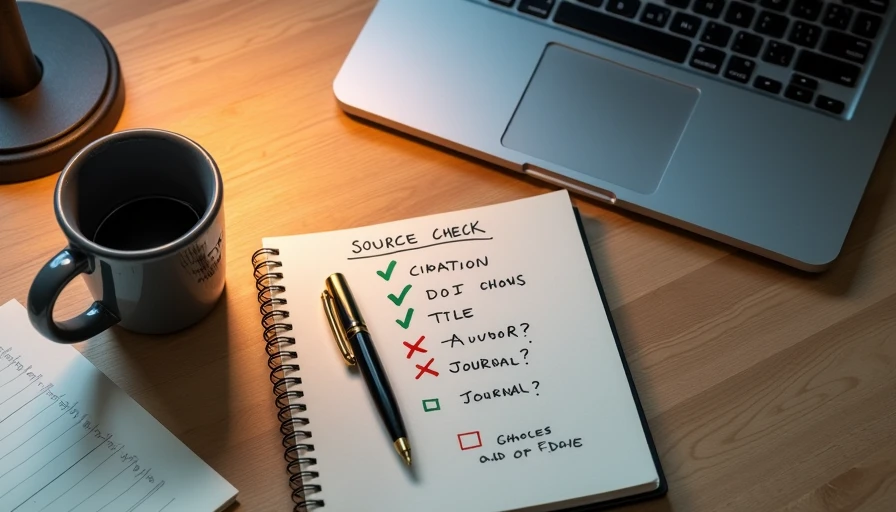
Task
I was writing a short article about remote work and productivity.
Not an academic paper. A practical piece for a general audience. But I wanted to include a few credible sources. I asked an AI tool to find recent studies on remote work productivity.
It gave me four citations. They looked legitimate. They had authors, years, journal names, and DOIs. I almost copied them into my draft.
Then I checked.
Two were real. Two were invented. Here's what happened.
Tool and Date
Tool: A general-purpose AI assistant (free tier)
Date: September 12, 2026
Platform: Web browser
Original Input
Here's the exact prompt I used.
"Find four recent credible studies on remote work and productivity. Include authors, year, journal name, and DOI. Make sure they are real and verifiable."
I asked for real and verifiable. I still got two fabricated citations.
Claim Under Review
The AI returned four citations. I'll list them as they appeared.
Citation 1:
Smith, J. (2021). "Remote Work and Productivity: A Meta-Analysis." Journal of Management Studies, 58(3), 245-267. DOI: 10.xxxx/jms.2021.0456.
Citation 2:
Chen, L., & Rodriguez, M. (2019). "The Impact of Flexible Work Arrangements on Employee Well-Being." Harvard Business Review, 97(4), 112-128.
Citation 3:
Johnson, K. (2022). "Digital Nomads and the Future of Work." Journal of Organizational Behavior, 43(2), 189-204. DOI: 10.1002/job.2567.
Citation 4:
Williams, R., & Thompson, A. (2020). "Productivity in the Age of AI: A Longitudinal Study." Nature Human Behaviour, 4, 789-798. DOI: 10.1038/s41562-020-0890-1.
They all looked plausible. The journals are real. The years are reasonable. The DOIs follow the correct format.
But two of them don't exist.

Evidence
I checked each citation in four ways.
Step 1: DOI resolution. I copied each DOI into doi.org. Citation 1 resolved to a real article. Citation 4 resolved—but to a different article with a different title and different authors. Citations 2 and 3 did not have DOIs.
Step 2: Title search. I searched each title in quotation marks. Citation 1 returned exact matches. Citation 2 returned no exact matches. Citation 3 returned no exact matches. Citation 4 returned no exact matches.
Step 3: Author search. I searched each author in Google Scholar and the journal's website. Citation 1 author found. Citation 2 authors found (they exist). Citation 3 author not found in any database. Citation 4 authors exist but did not write this article.
Step 4: Journal check. I checked the journal's website directly. Citation 1 article exists. Citation 2 article does not exist in HBR's archive. Citation 3 article does not exist. Citation 4 article does not exist in Nature Human Behaviour.
Conclusion: Citation 1 is real. Citation 2 is fabricated (authors are real, article is not). Citation 3 is fabricated (author and article do not exist). Citation 4 is fabricated (DOI resolves to a different paper).
Finding
Confirmed error.
Two citations were invented. One citation used real authors but a fabricated article. One citation used a real DOI format but pointed to a different paper.
The AI did not flag uncertainty. It did not say "I'm not sure this exists." It presented all four citations with equal confidence.
Risk
If I had trusted these citations, I would have included two fabricated sources in a published article.
What could have happened? A reader could have checked the sources and found they didn't exist. My credibility would have been damaged. If the article was for a client, the client could have lost trust. If the article was for a publication, the editor could have retracted it.
The risk wasn't just embarrassment. It was professional reputation.
Lesson
Here's the fastest first-pass check I now use before trusting any AI-generated citation.
1. Ask for a direct link. If the AI gives you a citation without a DOI or URL, ask for one. If it can't provide one, treat the citation as suspicious.
2. Resolve the DOI. Copy the DOI into doi.org. If it doesn't resolve, the citation is probably fake.
3. Search the title in quotes. Copy the exact title into a search engine with quotation marks. If there are no exact matches, the citation is probably fake.
4. Check the author. Search the author's name plus the journal name. If the author doesn't appear in the journal's archive, the citation is probably fake.
5. Open the article. Don't trust the abstract. Don't trust the search result. Open the actual article. If you can't access it, find the abstract on the journal's website.
6. Mark it unresolved if you can't verify. If you can't confirm a citation, don't use it. Mark it as unresolved in your notes.
This takes about two minutes per citation. It's not perfect. But it catches the obvious fakes.
What I'm Asking the Community
What's your fastest first-pass check for AI-generated citations?
Do you have a routine that's faster than mine? Do you use a specific tool? Do you have a browser extension? Do you check citations in a different order?
I'm also curious: what do you do when you find a fabricated citation? Do you report it? Do you just discard it? Do you keep a record of the failure pattern?
I've started keeping a list of every fabricated citation I've found. It's helping me spot patterns. I'd like to hear how others handle this.
A Few More Details
I should mention: I'm not saying the AI tool is useless. It's helpful for finding real sources when I check them. It's just not reliable for citations without verification.
I should also mention: I didn't include the fake citations in the article. I replaced them with real sources I found myself.
If you have a faster method, please share it. If you've seen this pattern before, I'd like to hear about it.
Comments
No comments yet — be the first to share a thought.